
Company Profile
In 2015, Zhejiang Noah Fluorochemical Co., Ltd was founded. And from this day on, it has been aimed to become the biggest and best manufacturer of of perfluoro (2-methyl-3-pentanone) (FK-5-1-12) and fluorochemicals. In 2016, Noah establised the national first 2,000 tons/year device for perfluoro (2-methyl-3-pentanone) (FK-5-1-12) and fluorochemicals. And in 2020, Noah set up the second device to form 5,000 tons/year capacity.
Why Choose Us
Our Certificate
The company has perfect quality control management system, passed the ISO9001 / ISO14001 / OHSAS18001 management system certification; FK-5-1-12 is UL listed, FM approved and REACH registered.
Production Equipment
Now the company has established 5000 tons of fine fluorine chemicals production equipment.
Production Market
Zhejiang Noah's perfluoro (2-methyl-3-pentanone) (FK-5-1-12) and fluorochemicals has been sold all over the world, and its quality has been highly comfirmed by all the customers worldwidely. Presently, we have customers from America, Brazil, England, France, Spain, Italy, Russia, Ireland, Turkey, Singapore, UAE, Saudi Arab, Malaysia, Tailand etc.
Professional Team
We are passionate about providing world-class service experiences.

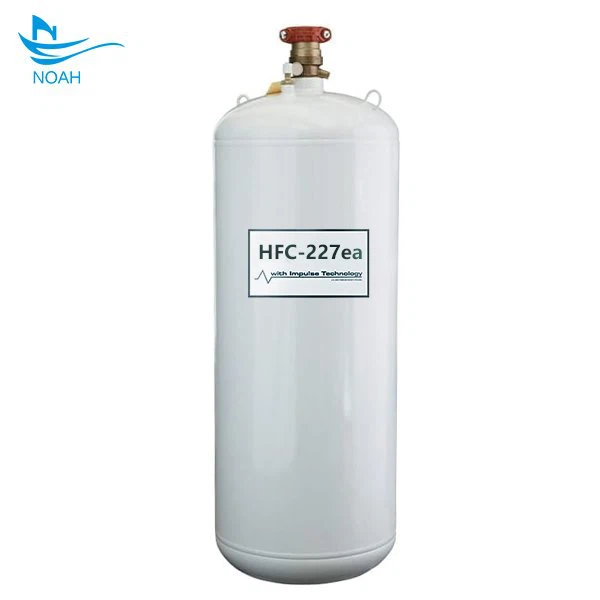
Hfc 227 gas is a gaseous halocarbon agent containing no particles; it leaves no oily residues on electronic equipment and can be removed from the protected space by ventilation. It is the first environmentally acceptable replacement for Halon 1301.

HFC-227ea Agent (1,1,1,2,3,3,3-heptafluoropropane gas) is a compound of carbon, fluorine and hydrogen (CF3CHFCF3).

HFC-227ea finds use in fire suppression systems in data processing and telecommunication facilities, and in protection of many flammable liquids and gases. hfc-227ea falls in the category of Clean Agents and is governed by NFPA 2001 - Standard for Clean Agent Fire Extinguishing Systems.

Gas hfc 227 provides superior fire protection in a wide range of applications from sensitive electrical equipment to industrial applications using flammable liquids.

HFC-227 fire suppressant is widely accepted and respected around the world, with a history of protecting the world's most crucial and irreplaceable assets. It's used in thousands of applications-including cultural property, data centers, and critical infrastructure-across more than 70 countries.

HFC-227ea gas is widely accepted and respected around the world, with a history of protecting the world's most crucial and irreplaceable assets. It's used in thousands of applications-including cultural property, data centers, and critical infrastructure-across more than 70 countries.

HFC-227 is known chemically as Heptafluoropropane. gas hfc-227 is a colourless gas which is liquified under pressure for storage. Like Halon 1301 it has a low toxicity level and is superpressurised with Nitrogen to 24.8bar(360psi).

HFC-227ea agent is accepted and respected worldwide, including a long history of protecting some of the world's most critical and irreplaceable assets.

HFC227ea is a clean agent fire extinguishant used as a flooding agent to help protect assets including data and data processing equipment in the event of a fire.
What is Heptafluoropropane
Heptafluoropropane is considered to be an ideal substitute for halon 1301 because of its high fire-extinguishing performance, low toxicity, no damage to the atmospheric ozone layer, and no pollution to the site of use. It has been included in the NFPA 2001 fire extinguishing supplies standard by the National Fire Protection Association. In addition, heptafluoropropane is also used as a refrigerant and a medical propellant.heptafluoropropane.
Heptafluoropropane (HFC-227ea) is a colorless, almost odorless, non-conductive gas at normal temperature and pressure. Its density is about 6 times that of air. It is a colorless and transparent liquid under its own pressure. It is non-toxic, non-flammable and non-corrosive. Sexual, with good thermal and chemical stability.
Benefits of Heptafluoropropane
Efficient fire extinguishing: Heptafluoropropane is an efficient fire extinguishing agent, similar to HFC-227ea. It extinguishes fires quickly by removing heat and interrupting the combustion chain, making it suitable for protecting critical infrastructure and valuable assets.
Chemical stability: Heptafluoropropane is chemically stable and non-corrosive, leaving no residue after discharge, reducing the risk of damage to sensitive equipment in applications such as data centers and museums.
Compatibility: It is generally considered a drop-in replacement for HFC-227ea, requiring minimal system modifications during the transition period, thus simplifying the upgrade process of existing fire suppression systems.
Safety: Heptafluoropropane does not pose an acute toxicity risk to the human body at its intended use concentration, making it a safe choice for inhabited spaces.
Heptafluoropropane Fire Extinguishing Principle

Heptafluoropropane chemical fire extinguishing reaction
Heptafluoropropane thermally decomposes during the fire extinguishing process to produce fluorine-containing free radicals such as CF3, CF2, CF3CFO and CFO. These fluorine-containing free radicals react with H, O, ·OH, HO2·, ·O2-, NO·, etc. during the combustion reaction. Active free radicals react to produce CO2, H2O, HF, etc., thereby interrupting the chemical chain reaction during the combustion process.
Physical fire extinguishing reaction of heptafluoropropane
(1) The fire extinguishing agent is sprayed into the protected area in a nearly liquid form. When the nozzle is ejected, the liquid state changes rapidly from a nearly liquid state to a gaseous state. Absorbs a large amount of heat during vaporization, reducing the temperature in the protected area and around the flame.
(2) The molecular weight of heptafluoropropane fire extinguishing agent is relatively large. When extinguishing a fire, some bonds in the molecules break and absorb heat, which has the effect of inhibiting combustion active groups such as free radicals and lowering the temperature.
(3) The gasification process of heptafluoropropane is rapid, and the concentration in the protected area increases rapidly, which can quickly reduce the partial pressure concentration of oxygen, reduce the burning speed of the flame, and gradually reduce the oxygen concentration to below the flammable concentration.

Heptafluoropropane does not contain chlorine or bromine, will not have a destructive effect on the atmospheric ozonelayer, It will not leave any residue or grease after release, It can also be discharged through normal exhaust channels, so it is very suitable as a fire extinguishing agent for data centers and server centers etc, Usually in these places heptafluoropropane fire extinguishing systems are installed, when a fire alarm occurs, heptafluoropropane is discharged from the tank, quickly draining the oxygen from the location of the fire and cooling the area to achieve the purpose of extinguishing the fire.
Although heptafluoropropane is relatively stable at room temperature, it still decomposes at high temperatures and produces hydrogen fluoride, producing a pungent taste. Other combustion products include carbon monoxide and carbon dioxide.
Contact with liquid heptafluoropropane can cause frostbite, so do not touch it unless necessary.
The main extinguishing mechanism of heptafluoropropane is to cut off the combustion chain, with extremely fast fire extinguishing speed, this is beneficial for protecting electronic equipment and precision instruments.
The non-toxic reaction concentration of heptafluoropropane is 9% (NOAEL=9%), and the toxic reaction concentration is 10.5% (LOAEL=10.5%), Its design concentration is generally less than 10%, which is safe for the human body, Its characteristic is good cleanliness (complete gasification in the atmosphere without leaving any residue).
It has good gas-phase electrical insulation and good physical properties.
Components of Heptafluoropropane
The heptafluoropropane gas fire extinguishing system includes fire extinguishing cylinder, high-pressure hose, check valve, pilot gas, selector valve, safety valve, pressure signal device (pressure switch), nozzle, high-pressure pipeline, etc.


1. Every fire extinguishing cylinder includes an agent storage cylinder, cylinder head control valve (container valve), Safety valve, manual valve, pressure gauge, Siphon, agent of heptafluoropropane, etc. Select different volumes of storage cylinders according to actual needs.
2. High-pressure hose is a device that connects fire extinguishers and one-way valves.
3. Between the high-pressure hose and the manifold there is a check valve. Its function is to prevent gas back-flow.
4. The pilot gas cylinder contains nitrogen gas, When a fire occurs, the pilot gas cylinder receives instructions to activate the gas to open the selection valve and container valve and release the extinguishing agent.
5. The pilot gas cylinder includes a gas cylinder, bottle head control valve(container valve), electromagnetic starter, Check valve, safety valve, manual valve, Pressure gauge, and starting gas.
6. Use safety valves to prevent system overpressure.
7. Use the selector valve to control the entry of fire extinguishing agents into the corresponding protected area, In the case of multiple protected areas.
8. Selecting the corresponding size selector valve based on the calculated pipe diameter.
9. The pressure switch is a signal device transmitted to the fire control panel when the fire extinguishing system starts the spraying room, informing the host that the fire extinguishing agent is being sprayed.
10. The nozzle is the outlet channel of the fire extinguishing agent, used to spray the HFC-227ea agent.
11. Use High-pressure pipelines to transport fire extinguishing agents and serve as channels for extinguishing agents.
12. Use High-pressure pipe fittings to connect high-pressure pipelines.
Heptafluoropropane is a type of gas fire extinguishing system. During the long-term use of fire-fighting cylinders, the cylinder body will become thinner due to corrosion from external pollution, and cracks will also appear due to moisture or other impurities in the cylinder corroding the cylinder. If it encounters high heat, the container will If the pressure increases, there is a risk of cracking and explosion. According to national fire regulations, fire gas cylinders must undergo regular comprehensive testing. The shelf life of heptafluoropropane cylinder equipment generally depends on the nature and quality of the cylinder, and generally ranges from 20 to 30 years.
The heptafluoropropane gas fire extinguishing system includes: fire extinguishing bottle set, high-pressure hose, fire extinguishing agent check valve, pressure signal, nozzle, high-pressure pipe fittings, etc.
The heptafluoropropane gas fire extinguishing system is suitable for fighting: electrical fires, solid surface fires, liquid fires, and gas fires that can cut off the gas source before extinguishing the fire.
Heptafluoropropane gas has the characteristics of cleanness, low toxicity, good electrical insulation, high fire extinguishing efficiency, and basically harmless to the human body.
Precautions for installation of heptafluoropropane gas fire extinguishing system
Heptafluoropropane is one of the earliest halon substitutes developed in China. Since its performance is similar to that of halon, it is in line with people's habit of using halon fire extinguishing systems for a long time, and its fire extinguishing efficiency is also high. Therefore, heptafluoropropane is currently the most widely used halon substitute product. , the clean gas fire extinguishing system with the most mature technology.
As a fire extinguishing agent, the fire extinguishing process of heptafluoropropane is completed through the change of physical phase, from liquid phase to gas phase and then decomposition. Its fire extinguishing is a mixture of physical and chemical effects.
The physical effect is mainly cooling. As far as the chemical effect is concerned, among the active radicals of halogen atoms, fluorine has the smallest free radical radius, and its ability to capture the active radicals H+ and OH- in combustion is low; in addition, the HF produced is stable (this is the amount of HF generated One of the biggest reasons), unlike HBr and HI, which have the effect of re-capturing OH-active radicals, their combustion chain scission effect is small.
The decomposition product HF produced by the chemical fire extinguishing effect of heptafluoropropane is its main negative effect. HF has a certain degree of toxicity and is corrosive under humid conditions. If it reaches a certain concentration, it will cause damage to the human body and equipment.
Is there any danger in the installation of heptafluoropropane gas fire extinguishing system? Let's briefly talk about what you need to pay attention to during the installation process of heptafluoropropane gas fire extinguishing system.
Heptafluoropropane gas fire extinguishing systems can be divided into heptafluoropropane gas fire extinguishing systems with pipe network and heptafluoropropane gas fire extinguishing systems without pipe network.
The on-site installation of the pipe-less heptafluoropropane gas fire extinguishing system is relatively simple. You only need to install the cabinet gas fire extinguishing system at the designated location, and then connect the drive line to the automatic fire alarm controller to complete the installation of the gas automatic fire extinguishing system.
Our Certificate
The company has perfect quality control management system, passed the ISO9001 / ISO14001 / OHSAS18001 management system certification; FK-5-1-12 is UL listed, FM approved and REACH registered.

FAQ
Hot Tags: heptafluoropropane, China, suppliers, manufacturers, in stock, made in China